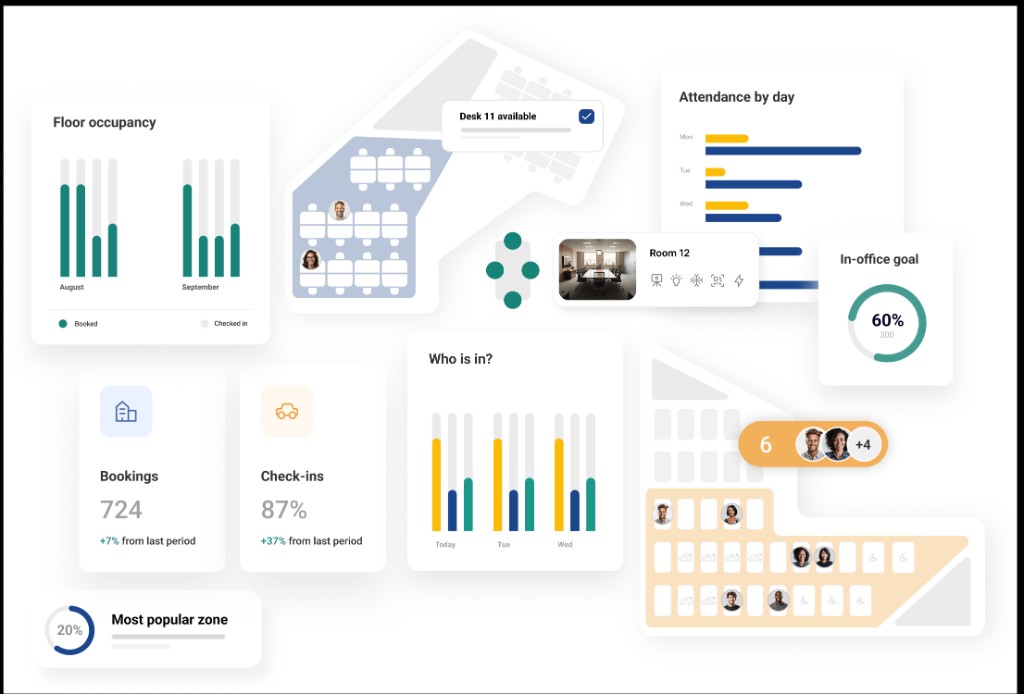
The right coworking space management software is now the difference between a space that runs itself and one that drowns in spreadsheets. It handles members, bookings, billing, access, and analytics from one system, so operators spend less time on admin and more time filling desks.
The market backs this up. According to CoworkingCafe, the United States alone crossed 9,100 active coworking locations and 164 million square feet by early 2026, growing roughly 15% year over year. Globally, flexible workspace is a market worth more than 20 billion dollars.
More spaces means more competition, and more competition means member experience and operational efficiency decide who wins. Manual processes do not scale past a few hundred members.
Below we cover the 10 platforms worth evaluating in 2026, what each one does best, the features that actually matter, the mistakes operators make, and how to choose a tool that fits your space rather than fighting it.
10 best coworking space management software for 2026
These are the 10 coworking platforms we recommend evaluating in 2026:
- Ronspot
- Nexudus
- OfficeRnD Flex
- Cobot
- Optix
- Spacebring
- Archie
- Coworks
- Yardi Kube
- andcards
| Platform | Best for | Starting price | Free trial | Key strength |
|---|---|---|---|---|
| Ronspot | Flex offices and desk, room, parking booking | Custom | Demo available | Booking, analytics, access |
| Nexudus | Full-featured operators | From ~$0.50/member | Yes | Customisation, 80+ integrations |
| OfficeRnD Flex | Established multi-site operators | Custom | Yes | Revenue and lease management |
| Cobot | Simple, white-label spaces | From ~$29/mo | Yes | Ease of use, 90+ countries |
| Optix | Mobile-first communities | From ~$159/mo | Yes | Member app experience |
| Spacebring | Member service and automation | From ~$125/mo | Yes | Easy setup, automations |
| Archie | Hybrid plus coworking | From ~$129/mo | Yes | Dual hybrid and flex use |
| Coworks | Community-focused spaces | Custom | Yes | Community management |
| Yardi Kube | All-in-one real estate operators | Custom | No | Accounting and billing depth |
| andcards | Member-friendly apps | From ~$99/mo | Yes | Clean booking app |
1. Ronspot
Ronspot is a workplace management platform that covers desk booking, meeting room scheduling, and parking from a single app.
It is the strongest fit for flexible offices, corporate coworking, and internal flex spaces that need a simple, employee-first booking and analytics layer rather than a full membership billing engine.
What makes it different is the combination of booking, presence detection, and analytics in one place. Members and employees book through the mobile app, Microsoft Teams, or a browser, so adoption stays high and training stays low.
Automatic check-in via Wi-Fi and access control means the system knows who is actually in the space, not just who reserved. That presence data feeds an analytics layer showing occupancy trends, peak usage by zone, and booking patterns over time.
On the security side, Ronspot is ISO 27001 certified, supports SSO, and handles multi-site rollouts with centralised admin. It integrates with occupancy sensors and access control, which is exactly what a flex space needs to manage real-world entry and desks.
We are a solution, not a consultancy. If your priority is desk, room, and parking booking with reliable occupancy data, this is where we are strong. If you also need recurring membership invoicing, pair us with a billing tool or look at the dedicated operator platforms below.
- Desk, meeting room, and parking booking in one app
- Automatic Wi-Fi check-in and auto-release of no-shows
- Workplace analytics for occupancy and capacity decisions
- Microsoft Teams, SSO, sensor, and access control integrations
- ISO 27001 security with centralised multi-site administration
| Feature | Detail |
|---|---|
| Best for | Flex offices, corporate coworking, hybrid spaces |
| Key features | Desk, room, parking booking, analytics, auto check-in |
| Integrations | Microsoft Teams, SSO, sensors, access control |
| Security | ISO 27001:2022 certified |
| Pricing | Custom (book a demo) |
2. Nexudus
Nexudus is the most full-featured platform on this list and a long-time favourite of established operators. It covers members, billing, bookings, access, marketing, and a member portal in one system.
Its biggest strengths are customisation and integrations. You can edit the member portal with HTML and CSS, and the platform offers more than 80 native integrations across common coworking systems, plus AI features for churn prediction.
The trade-off is complexity. The learning curve is steep, and teams that want something simple to set up may find parts of the admin interface dense. It rewards operators who invest the time.
- Best for full-featured, customisation-heavy operators
- Member billing, bookings, access, marketing, CRM
- 80+ native integrations and a fully editable portal
- Steeper learning curve than lighter tools
3. OfficeRnD Flex
OfficeRnD Flex targets established operators and flex brands that need advanced workflows across multiple locations. It excels at the business side of flexible real estate.
Where it stands out is revenue recognition, lease management, and complex contract rules. Optional add-ons cover visitor management and sales flows, so larger operators can run growth and front desk from the same stack.
The main consideration is pricing transparency. OfficeRnD now leans on custom quotes rather than published tiers, so you will need a sales conversation to scope cost.
- Best for established multi-site operators
- Revenue recognition, lease and contract management
- Add-ons for visitor management and sales
- Custom pricing, geared to larger operations
4. Cobot
Cobot began as an internal tool for a Berlin coworking space before becoming a standalone product, and it now serves spaces across more than 90 countries. Its focus is keeping things simple.
The platform handles core tasks without heavy training: memberships, bookings, invoicing, and access. White-label capabilities come included with subscriptions rather than as paid add-ons, which is a real plus for branded spaces.
Cobot suits operators who want reliable fundamentals and a clean interface over a sprawling feature set. It is a dependable middle ground between basic tools and complex suites.
- Best for simple, white-label coworking spaces
- Memberships, bookings, invoicing, access control
- White-label included in the subscription
- Reliable core features over deep complexity
5. Optix
Optix is built around a mobile-first member experience and is consistently rated among the easiest platforms to use. The member app is the centre of the product.
Members book spaces, pay, and access services from a polished app, which suits modern communities that expect a consumer-grade experience. Operators get the admin tools to manage memberships and bookings behind that app.
The focus on app experience means Optix is a strong pick when member satisfaction and retention are your main levers. Spaces that compete on community and design tend to like it.
- Best for mobile-first coworking communities
- Polished member app for booking and payments
- High ease-of-use ratings
- Strong fit when retention drives the business
6. Spacebring
Spacebring focuses on member service and automation, with a reputation for fast setup. It aims to remove repetitive admin so small teams can run busy spaces.
The platform automates billing, bookings, and member communication, and includes benefits and perks features to build community value. Operators highlight how quickly they can go live compared with heavier suites.
It is a good fit for small to mid-sized spaces that want automation without a long implementation. The feature depth is lighter than Nexudus, but the simplicity is the point.
- Best for member service and automation
- Automated billing, bookings, and communication
- Fast setup and easy onboarding
- Lighter feature depth than enterprise suites
7. Archie
Archie covers both hybrid workplaces and coworking spaces, which makes it useful for operators who serve corporate flex clients alongside traditional members.
The platform handles desk and room booking, visitor management, memberships, and analytics. Because it spans hybrid and flex, it can fit a space that rents to companies running their own internal booking policies.
That dual focus is the differentiator. If your space blends corporate hybrid tenants with individual members, Archie speaks to both audiences from one tool.
- Best for spaces blending hybrid and coworking
- Desk and room booking, visitor management, memberships
- Analytics across hybrid and flex use
- Dual audience focus is the standout
8. Coworks
Coworks is built around community management. It treats the member relationship, not just the transaction, as the core of the product.
The platform covers bookings, billing, and a member app, but leans into community features like events, directories, and engagement tools. For spaces where culture and networking are the selling point, that focus matters.
Operators who see their space as a community first and a real estate product second tend to align with the Coworks philosophy. It is less about yield optimisation and more about member connection.
- Best for community-focused coworking spaces
- Bookings, billing, and a member app
- Strong events, directory, and engagement tools
- Community-first rather than yield-first
9. Yardi Kube
Yardi Kube comes from a real estate software heritage and offers an all-in-one platform with deep accounting. It is aimed at operators who want billing, payments, and the general ledger handled natively.
The platform covers member management, bookings, access, and a member app, but its real advantage is financial depth. For operators who treat the space as a property with full accounting needs, that integration is valuable.
The trade-off is that it can feel heavier and more enterprise than nimble, design-led tools. It rewards operators who prioritise financial control over interface polish.
- Best for all-in-one real estate operators
- Deep accounting, billing, and general ledger
- Member management, bookings, access, app
- Enterprise feel over lightweight design
10. andcards
andcards focuses on a clean, member-friendly booking app and an approachable admin experience. It is popular with spaces that want a modern app without a steep setup.
The platform handles room and desk bookings, payments, visitor management, and member communication. The interface is simple enough that members adopt it quickly and operators can manage day to day without specialist training.
andcards suits small to mid-sized spaces that value a tidy member experience and quick onboarding over the deepest possible feature set. It is a practical, friendly option.
- Best for spaces wanting a clean member app
- Room and desk bookings, payments, visitor management
- Quick onboarding and easy admin
- Friendly fit for small to mid-sized spaces
What is coworking space management software and what it does
Before comparing features, it helps to be clear on what this category actually covers and where the boundaries sit.
A single system for members, space, and money
Coworking space management software is the operating system of a flex space. It connects who your members are, what they can access, when they book, and what they owe into one place.
Instead of juggling a booking calendar, a spreadsheet for invoices, and a separate door system, the software ties them together. A membership status drives booking rights, access permissions, and billing automatically.
That integration is the whole point. When a member upgrades or cancels, every connected system updates without an operator touching three tools.
How it differs from desk booking software
Desk booking software manages reservations for workstations and rooms. Coworking management software does that too, but adds the commercial layer: memberships, recurring billing, and member lifecycle.
The distinction matters when you choose a tool. A corporate office running hybrid work may only need booking and analytics. A coworking operator selling memberships needs billing and access control on top.
Knowing which side of that line you sit on saves money. Buying a full operator suite for a simple internal flex space is overkill, and the reverse leaves you short.
Who actually uses it
The core users are coworking operators, but the audience is wider now. Corporate flex spaces, innovation hubs, university incubators, and property managers running flexible floors all rely on it.
As coworking became part of corporate real estate strategy, the line between an office and a flex space blurred. Many companies now run internal coworking-style floors for their own hybrid teams.
That overlap is why booking-first platforms and operator-first platforms both appear on lists like this one. The right pick depends on whether you sell space or simply manage it.
What to look for in coworking space management software
The market is full of feature checklists. Here is what separates tools that run a space smoothly from tools that create new admin work.
Automated billing and payments
This is the financial backbone. The software should handle recurring memberships, prorations, credit ledgers, tax, and failed-payment recovery without an operator chasing each invoice.
Integration with a payment processor such as Stripe lets you charge memberships, day passes, and resource rentals automatically. Manual invoicing does not scale past a small space.
Look closely at how the tool handles dunning and failed payments, because recovering a declined card automatically protects revenue that operators otherwise lose every month.
Access control integration
A flex space lives and dies on entry. The software should tie door unlocks, visitor invites, and after-hours rules back to active memberships.
Strong platforms integrate with access systems like Kisi, Brivo, Salto, and PDK for keyless entry based on membership status. When a membership lapses, access should end automatically, not after a manual review.
This link between billing and the front door is what makes a space self-running. It also closes the security gap that manual key handling always leaves open.
Booking engine and member app
Members expect to book a room or desk in seconds from their phone. A smart booking engine prevents double bookings and syncs with Google and Outlook calendars for real-time availability.
The member app is where daily engagement happens: booking, paying, unlocking doors, and connecting with the community directory. A clunky app pushes members to email the front desk, which defeats the purpose.
For practical patterns on setting fair booking rules, our guide to desk and parking booking priorities covers approaches that translate well to flex spaces.
Occupancy analytics
After a few weeks of data, the software should answer real questions. Which rooms sit empty? When are peaks? Which memberships churn? What is the real occupancy versus the booked occupancy?
This data drives pricing, layout, and expansion decisions worth real money. Without it, operators guess at capacity and leave revenue on the table.
The best tools turn raw bookings into trends a manager can act on. Our 2026 workplace statistics report shows how occupancy data is reshaping space decisions across the sector.
Common mistakes when choosing coworking management software
Even experienced operators trip on the same issues. Avoiding these saves months of frustration and a costly migration later.
Buying more platform than the space needs
The most common mistake is over-buying. A full operator suite with revenue recognition and lease management is powerful, but a 40-member space or an internal corporate floor may only need booking and access.
Match the tool to your model. A focused platform that staff and members actually use beats a complex suite that sits half-configured. You can always upgrade as you grow.
Cutting manual admin matters more than feature count. The right setup quietly removes a surprising amount of routine work from your team’s day, which is where the real return on the software shows up.
Ignoring access control from day one
Operators often treat door access as a later add-on, then discover their software does not integrate with their hardware. Retrofitting access integration is painful and sometimes impossible.
Decide on your access system and confirm the software supports it before you sign. The link between membership status and the front door is too important to bolt on afterwards.
This is also a security issue. Manual key handover or shared codes create risk that automated, membership-driven access removes entirely.
Underestimating member adoption
The slickest admin dashboard means nothing if members will not use the app. If booking a room takes too many taps, members default to messaging the front desk and the automation breaks.
Test the member experience before committing. Put the app in front of a few members with no training and watch whether they can book and pay in under a minute.
Accurate presence data depends on adoption too. Tools like Wi-Fi check-in attendance tracking only deliver clean data when the daily flow is frictionless.
How to choose the best coworking space management software
With the criteria clear, here is a practical way to narrow the field without weeks of demos.
Define your model first
Start by naming what you are. A membership-selling operator needs billing and access at the core. A corporate flex floor needs booking and analytics, with billing optional.
Writing this down filters the list fast. Half the tools here are built for operators monetising memberships, and the other half shine at booking and occupancy for internal spaces.
Getting this right prevents the most expensive mistake: buying for the wrong model and migrating a year later.
Map your integrations before you shortlist
List the systems you already use: payment processor, access hardware, calendars, and accounting. Then check each platform against that list before you fall for a demo.
A tool that does not integrate with your door system or your accounting package will create manual work no feature list can offset. Integrations are where deals quietly fail.
Native integration beats a workaround every time, so weight this heavily in your scoring.
Test with real members and staff
Demo environments are always polished. The real test is your front desk team and a handful of members using the tool with no training for a week.
Watch for friction: confusing booking flows, slow apps, or admin steps that take too long. If your own team hesitates, members will too.
Pair that test with a billing dry run. Process a real membership cycle, including a failed payment, to see how the software handles the messy reality of recurring revenue.
The future of coworking space management
Three shifts will define the next few years, and each one raises the bar for the software operators choose.
Coworking becomes corporate infrastructure
Flexible space is now a core part of corporate real estate strategy, not a fringe option. Companies use coworking and internal flex floors to manage hybrid teams and stay nimble on leases.
That pulls operator software and workplace software closer together. Platforms that handle both member monetisation and corporate booking policies will have an edge as the audiences merge.
Automation and AI take over admin
The busywork of billing, dunning, and churn prediction is moving to automation. AI features that flag at-risk members or surface marketing opportunities are becoming standard rather than premium.
Operators who lean into this free their teams for community and sales. Broader hybrid work statistics show the same automation trend reshaping every kind of workplace.
Data becomes the deciding feature
Occupancy and revenue analytics are shifting from a reporting tab to the reason operators buy. The tools that turn data into pricing and layout decisions will win.
As research from McKinsey on productivity shows, the workspace decisions that pay off are grounded in data, not instinct.
Expect analytics depth to keep climbing the buying checklist, a shift echoed in Gartner workplace predictions for the years ahead.
Ronspot: the booking and analytics layer for flex spaces
We built Ronspot for spaces where the priority is filling desks and rooms efficiently and knowing who is actually in, with the occupancy data to back every layout and capacity decision.
Where Ronspot fits a coworking strategy
We are a solution, not a consultancy. If you run a corporate flex floor, an internal coworking space, or a hybrid office, Ronspot gives you booking and analytics your people will actually use.
- One app for desk, room, and parking booking across every site
- Automatic Wi-Fi check-in and auto-release to kill no-shows
- Occupancy analytics for layout, capacity, and lease decisions
- Access control and sensor integrations for real-world entry
- ISO 27001 security, SSO, and centralised multi-site admin
For operators who also sell memberships, the honest answer is to pair Ronspot with a billing platform. Where we lead is the booking experience and the occupancy data that makes a flex space run on facts, not guesswork.
When you are ready to see how Ronspot fits your space, book a free demo.
Frequently Asked Questions
What is the best coworking space management software?
The best coworking space management software depends on your model. For full-featured operators, Nexudus and OfficeRnD Flex lead on billing and customisation, while Cobot, Spacebring, and Optix win on simplicity.
For flex offices and internal coworking that prioritise booking and occupancy analytics, Ronspot is the strongest fit. Match the tool to whether you sell memberships or simply manage space.
How much does coworking space management software cost?
Pricing varies widely. Entry tools start around $29 to $159 per month for small spaces, while per-member pricing can begin near $0.50 per member. Established operator suites like OfficeRnD Flex and Yardi Kube use custom quotes that scale with locations and features. Always model cost against your member count and the number of sites you run.
What features should coworking management software include?
The core features are automated billing and payments, access control integration, a booking engine, a member app, and occupancy analytics.
Billing should handle recurring memberships and failed payments automatically, and access control should tie door entry to membership status. Booking should prevent double bookings and sync with calendars, while analytics reveal occupancy and churn trends.
Can coworking software handle billing and access control together?
Yes. Strong platforms link membership status directly to both billing and access. When a member pays, their door access stays active, and when a membership lapses, access ends automatically. Look for native integrations with payment processors like Stripe and access systems like Kisi, Brivo, Salto, or PDK so the two work as one.
Is coworking space management software only for coworking operators?
No. While operators are the core users, corporate flex spaces, innovation hubs, university incubators, and property managers running flexible floors all use it. As coworking became part of corporate real estate strategy, many companies adopted these tools to run internal flex spaces and hybrid offices, not just to sell memberships.
How long does it take to implement coworking management software?
Lightweight tools with simple setup can go live in days, while mid-range platforms with billing, access integration, and a member portal usually take one to three weeks.
Full operator suites with accounting, multi-site configuration, and custom portals can take four to eight weeks. The biggest variable is integration setup, especially access hardware and payment systems.