Few operational headaches are as constant as hospital staff parking. Demand runs around the clock, shifts overlap, and every morning a wave of nurses, doctors, and support staff arrives at once, often competing for the same spaces as patients and visitors.
When a clinician spends 15 minutes circling for a spot, the cost is not just frustration. It is late shift starts, added stress before a demanding day, and the perception that staff are being pushed aside on their own campus.
The good news is that staff parking is the most predictable slice of hospital parking demand. You know who your employees are, when their shifts start, and roughly how many vehicles arrive. That predictability is exactly what makes it solvable with the right system.
This guide covers why hospital staff parking is so hard to manage, what a good solution looks like, the features that actually matter, and how to roll out a new system without a staff backlash.
Why hospital staff parking is so hard to manage
Before fixing it, it helps to understand why the problem persists at almost every health campus, regardless of size or budget.
Demand runs 24 hours a day
Hospitals never close. Unlike a corporate office with a single morning rush, a hospital has shift changes through the day and night, each creating its own surge of arrivals and departures.
That round-the-clock pattern means parking is rarely empty but rarely calm. A space that frees up at the end of a day shift is claimed minutes later by someone starting an evening rotation.
Managing this manually is almost impossible. Without data on who is on shift and when, facilities teams are guessing at demand that shifts by the hour.
Staff and patient parking get tangled
The core tension is keeping staff and patient parking separate. Patients and visitors need close, easy access, and staff should never be seen taking the spaces meant for the people they care for.
In practice, on-grade lots often get earmarked for new clinical buildings, which pushes staff parking to the edge of the campus. It is easier to move employees farther out than patients, so staff absorb the inconvenience.
Without a clear system, the boundary blurs. Staff drift into patient areas during busy periods, and goodwill erodes on both sides.
Safety and shift changes raise the stakes
Because hospitals operate overnight, many staff walk to their cars in the dark after long shifts. Where you place staff parking is a genuine safety question, not just a convenience one.
Shift changes concentrate this. Large numbers of people move between the building and the car park at the same hours, so lighting, routes, and proximity all matter for staff wellbeing.
A parking system that ignores shift timing makes safety worse. One that aligns spaces with shift patterns can keep staff closer and movements predictable.
What good hospital staff parking management looks like
A well-run staff parking operation turns a daily scramble into a quiet, predictable routine. Here is what that looks like in practice.
Dedicated staff zones with controlled access
The foundation is dedicated employee lots or zones, separated from patient and visitor areas. Access is tied to credentials, so only staff can enter.
Barrier gates open on a staff badge, key fob, or licence plate recognition at designated entry points. That keeps patient spaces protected and gives staff a reliable place to park.
This separation also ends the perception problem. When employees have their own clearly defined zone, no one accuses them of taking a patient’s spot.
Real-time availability and booking
The biggest shift is moving from “turn up and hope” to knowing a space is waiting. Staff book or are allocated parking that matches their shift, so they arrive with certainty.
Real-time availability means the system shows what is open before someone drives in. That alone removes the circling that wastes time and fuel every morning.
For teams with more demand than spaces, this is where fairness rules come in, which we cover next.
Fair allocation when demand exceeds supply
Most hospitals have more staff than spaces, so the question is how to share a scarce resource fairly. A good system makes the rules transparent instead of first-come, first-served chaos.
Credit or priority based allocation is one proven approach. Our explainer on a credit-based parking system shows how giving staff a fair, rules-driven way to claim spaces reduces conflict.
Fairness is what makes a system stick. When staff trust the rules, they stop gaming the lot and the daily tension fades.
Key features to look for in a hospital staff parking system
Not every parking tool fits a 24/7 healthcare environment. These are the features that separate a system that works from one that adds admin.
Credential-based access control
The system must tie entry to staff identity. Badge, fob, or licence plate recognition should open gates automatically, with no manual checks at peak times.
This keeps unauthorised vehicles out and patient zones protected. It also generates a record of who parked where and when, which is useful for both security and planning.
License plate recognition is especially valuable in healthcare. It scans plates, flags vehicles without valid permits, and alerts staff without slowing the morning flow.
Shift-aware allocation
A hospital system has to understand shifts. Allocation should map to rotations, so a night-shift nurse and a day-shift doctor can share the same space at different hours.
This is where generic office parking tools fall short. They assume a single daily pattern, while a hospital needs parking that turns over with each shift change.
Shift-aware allocation also doubles capacity on paper. One space used across two shifts serves two employees, which eases the supply gap without new construction.
Analytics and permit management
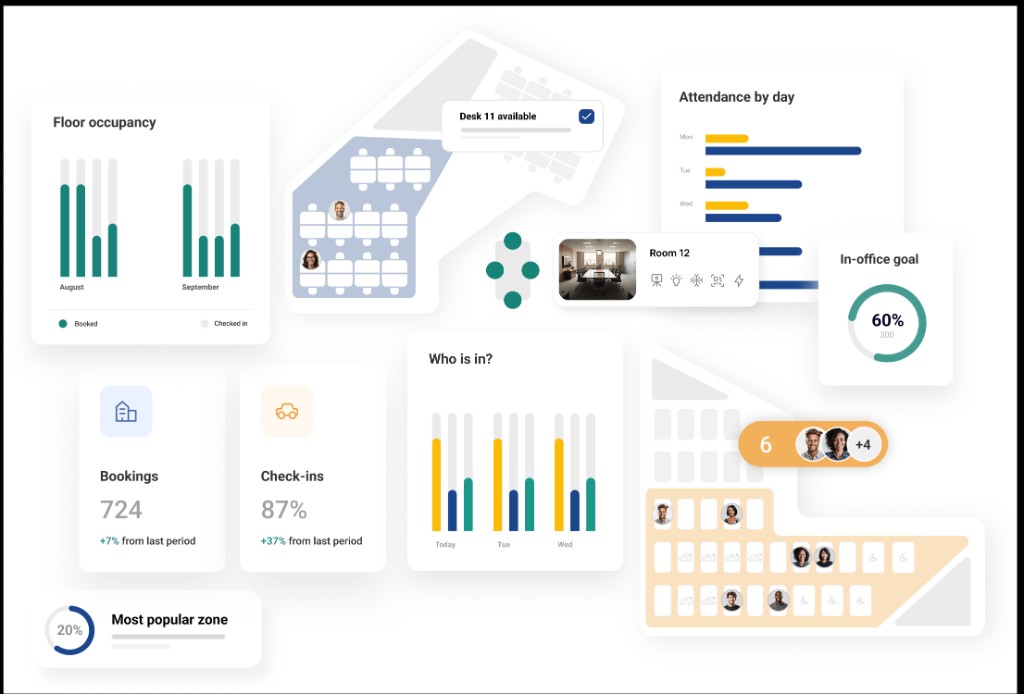
You cannot improve what you cannot measure. The system should track usage, manage permits, and report on occupancy by zone and time of day.
That data answers the questions facilities teams struggle with: which lots fill first, when peaks hit, and how many permits the campus can actually support. For a fuller list, see these staff parking management features worth prioritising.
Permit management also cuts admin. Issuing, revoking, and tracking permits digitally replaces spreadsheets and clipboard checks that never stay current.
A simple app for staff
The people using the system every day are clinicians, not parking officers. The staff-facing app has to be fast and obvious, or adoption collapses.
Booking or checking availability should take seconds from a phone before leaving home. Anything slower and staff revert to old habits and ignore the system.
A clean app also supports fairness. When everyone can see availability and rules in the same place, the process feels transparent rather than arbitrary.
How to roll out a staff parking system without backlash
Parking is emotional. Change it badly and you generate complaints for months. Here is how to introduce a new system smoothly.
Communicate the why before the change
Staff need to understand the problem you are solving. Frame the new system around fairness and reliability, not control or restriction.
Explain that the goal is to guarantee staff access, separate them from patient spaces, and end the daily scramble. When people see the benefit to them, they accept the change.
Silence breeds suspicion. A clear message before launch prevents the rumour that management is taking parking away.
Start with one shift or department
Do not switch the whole campus overnight. Pilot the system with a single department or shift, gather feedback, and fix the friction before scaling.
The pilot group becomes proof that the system works. Their experience, good or bad, tells you exactly what to adjust before a wider rollout.
This staged approach also protects trust. A messy campus-wide launch is hard to recover from, while a small pilot contains any early problems.
Use the data to keep improving
Once live, watch the occupancy data and act on it. If a lot fills before a shift starts, adjust allocation. If spaces sit empty, reassign them.
Sharing results openly helps too. When staff see that the system is genuinely easing the morning rush, support grows and complaints fade.
The same fairness lesson that prevents office parking disputes applies here. Our guide to stopping parking hogging at the office shows how clear rules keep a shared lot peaceful.
The real cost of poor hospital staff parking
It is easy to treat parking as a minor facilities issue. In a hospital, the knock-on effects reach much further than the car park.
Stress and late shift starts
A clinician worried about finding a space starts the day stressed before seeing a single patient. That pressure is the last thing a demanding healthcare role needs.
When parking runs late, shifts start late. In a hospital, a delayed handover has real consequences for patient flow and team coordination.
Reliable parking removes a daily source of friction. Research from McKinsey on productivity shows that removing small, repeated operational frictions adds up across an organisation.
Recruitment and retention pressure
Healthcare faces severe staffing pressure, and everyday experience shapes whether people stay. Parking is a visible, daily signal of how an employer treats its staff.
A frustrating commute and a scramble for a space tell employees they are an afterthought. A reliable, fair system tells them the opposite.
Employee experience is now a retention lever, not a perk, and the bar keeps rising. Broader hybrid work statistics show staff judge employers on the small frictions of daily working life.
The same logic applies to parking. Gartner workplace predictions place experience at the centre of keeping talent.
Lost capacity and access
Poorly managed parking wastes the asset you already have. Spaces sit empty in one lot while staff circle another, because no system balances demand.
That inefficiency has a wider cost. The American Hospital Association has noted that transportation and access barriers, including parking, contribute to millions of Americans foregoing or delaying care each year.
Getting staff parking right frees capacity and protects access for everyone on campus. It is an operational fix with a human payoff.
Ronspot: a smarter way to manage hospital staff parking
We built Ronspot to make shared spaces predictable, and hospital staff parking is exactly the kind of round-the-clock, high-demand problem it solves.
What Ronspot helps hospitals control
We are a solution, not a consultancy. You plug Ronspot in and give staff a fair, app-based way to secure parking that matches their shifts, while facilities teams get the data to manage demand.
- App-based parking booking that matches shift patterns
- Credit and rules-based allocation for fair, transparent access
- Real-time availability so staff stop circling for a space
- Occupancy analytics by zone and time to plan capacity
- Integrations with access control for credential-based entry
The result is a staff car park that runs quietly in the background. Staff arrive knowing a space is waiting, patient areas stay protected, and managers finally see what is really happening across every lot.
For modern healthcare teams, that reliability is more than convenience. It is one less daily stress for the people who can least afford it, and one more reason to stay.
When you are ready to see how Ronspot fits your campus, book a free demo.
Frequently Asked Questions
What is the best way to manage hospital staff parking?
The best way to manage hospital staff parking is a dedicated, credential-controlled system that aligns spaces with shift patterns.
Tie access to badges or licence plate recognition, separate staff from patient zones, and use a booking app with fair allocation rules. Add occupancy analytics so facilities teams can plan around real demand rather than guessing.
How do hospitals stop staff taking patient parking?
Hospitals stop staff using patient parking by creating dedicated, access-controlled staff zones. Barrier gates that open only on staff credentials keep employees in their own areas and patient spaces protected. A clear, fair allocation system removes the incentive to drift into patient lots, since staff have a reliable space of their own.
Can one parking space serve more than one staff member?
Yes. Because hospitals run multiple shifts, a single space can serve a day-shift and a night-shift employee at different hours. Shift-aware allocation in parking software turns over each space as rotations change, which effectively increases capacity without building anything. This is one of the biggest advantages of a digital staff parking system.
How does parking software handle 24/7 hospital shifts?
Good parking software maps allocation to shift times rather than a single daily pattern. It releases and reassigns spaces as shifts change, shows real-time availability for the next arrivals, and records usage around the clock. That continuous, shift-aware management is what generic office parking tools usually lack.
Why is hospital staff parking so stressful for employees?
Hospital staff parking is stressful because demand is high, shifts overlap, and staff often compete with patients for limited spaces. Circling for a spot before a demanding shift adds pressure and can cause late starts. A reliable system that guarantees a space removes this daily friction and improves the start of every shift.
Does better staff parking help with retention?
Yes. Parking is a visible, daily part of the employee experience, and healthcare faces strong staffing pressure. A fair, reliable system signals that an employer values its people, while a daily scramble signals the opposite. Removing that friction supports wellbeing and is one practical lever for retaining clinical and support staff.