For a facilities manager, returning teams to the office is not one task. It is an operating program that combines safety, capacity, communication, and daily execution under changing attendance patterns.
The old approach to “reopening” was often a one-time checklist. In 2026, that is not enough. Attendance is uneven, collaboration peaks are concentrated, and expectations around workplace reliability are much higher.
This guide is a practical playbook for facilities leaders who need to run a stable return-to-work model, not just launch one.
What changed in the facilities role
Pre-pandemic, many workplace routines were predictable: fixed schedules, stable occupancy, and lower pressure on real-time capacity controls.
Now facilities teams manage fluid attendance, dynamic room demand, and stronger expectations from leadership around measurable outcomes. The role has shifted from site support to operational control center.
This change also reflects labor-market reality. Telework remains a structural factor in many sectors, as shown in Bureau of Labor Statistics telework. For facilities managers, that means planning for mixed presence as a baseline condition.
The first 30 days: set the operating spine
The fastest way to lose control in a return-to-work phase is to launch without governance.
Your first month should focus on three things: decision rights, site rules, and visibility.
1) Define who decides what
Create a simple RACI for facilities, HR, IT, and business leaders. Clarify who owns occupancy thresholds, who approves exceptions, and who communicates policy changes.
Without this, frontline teams receive mixed instructions and confidence drops quickly.
2) Publish workplace rules before peak attendance
Teams need clarity on desk booking windows, meeting room etiquette, check-in expectations, and escalation paths.
Rules should be practical and short enough to use daily, not long policy documents nobody reads.
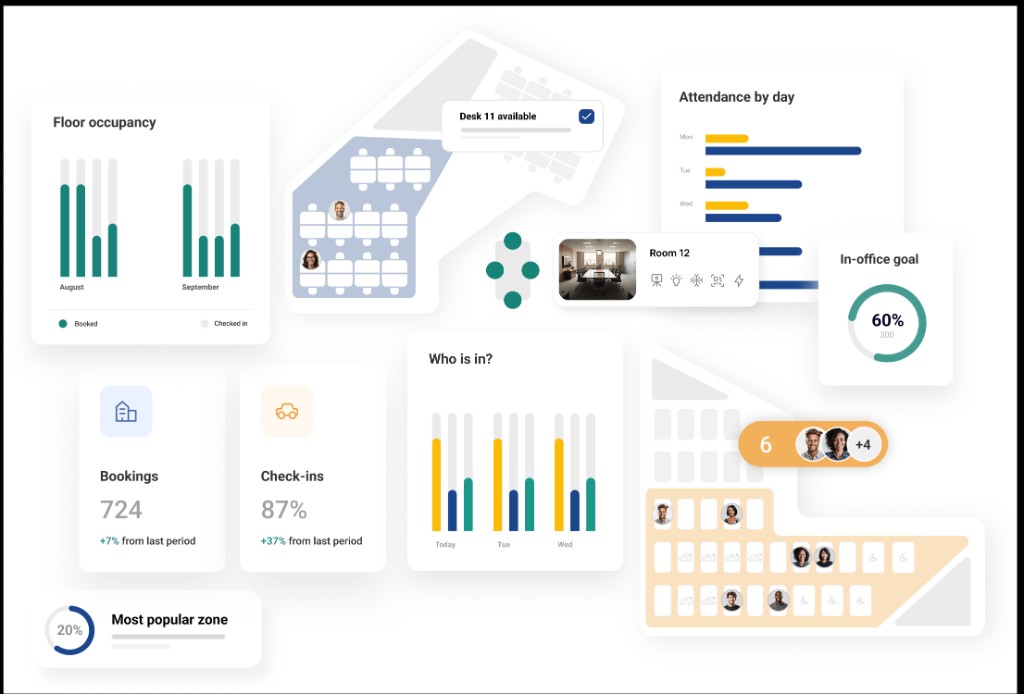
You need one source of truth for daily occupancy, booking conflicts, no-show signals, and unresolved incidents.
A shared dashboard prevents reactive firefighting and makes shift decisions faster.
Capacity management: stop treating headcount as occupancy
A common return-to-work error is assuming total headcount predicts office demand.
Real demand comes from behavior: anchor days, team rituals, project milestones, and visitor patterns.
Model demand by day and zone
Track expected attendance by weekday and by zone type, then compare that with actual usage.
This reveals hidden pressure points early, especially in meeting rooms and collaboration areas.
Use policy to smooth peaks
If two or three days carry most attendance, facilities should coordinate with leadership on staggered anchor patterns.
This is often more effective than expanding physical capacity.
Resource access can become political during return phases. Clear booking logic helps prevent this.
Practical priority rules are similar to the framework we outlined in desk and parking booking priorities.
Safety execution without operational drag
Safety controls fail when they create too much manual overhead.
The objective is a repeatable operating rhythm where hygiene, occupancy, and communication run with minimal daily friction.
Translate safety policy into routines
Define who verifies cleaning completion, who updates incident logs, and who closes actions.
Keep cadence explicit: daily checks, weekly reviews, and monthly control updates.
Tie cleaning scope to actual space usage
Usage-based cleaning improves quality and reduces waste versus blanket assumptions.
Automation can help by converting daily occupancy signals into cleaning action lists for operations teams.
Keep escalation paths short
Site issues should move through one clear route with response targets.
Long escalation chains create uncertainty and reduce employee trust in return-to-office commitments.
Communication model for anxious transitions
Return-to-work communication should not be generic.
Different audiences need different information at different times.
Employees need predictability
They need to know what to expect before arrival: booking steps, capacity expectations, arrival flow, and support contacts.
The more predictable the journey, the lower the day-one friction.
Managers need operational context
People managers should understand why attendance patterns are being coordinated and what behaviors are expected from their teams.
Without manager alignment, policy consistency breaks quickly.
Leadership needs outcome reporting
Executives usually need concise reporting on occupancy stability, risk trends, and operational load.
Facilities teams gain influence when they report outcomes, not only activities.
Technology stack facilities managers actually need
Tools should reduce manual coordination, not add extra process layers.
For most return-to-work programs, the minimum effective stack includes:
- booking controls for desks and rooms
- visibility into live and planned occupancy
- no-show and release logic for shared resources
- operational reporting for admin and leadership
Standardized admin workflows matter as much as features. This is why we recommend operational hygiene resources like Ronspot admin panel tips.
When manual admin is already stretched, automation opportunities can produce fast gains. A practical benchmark is this list of 18 workplace automations.
KPI system for return-to-work control
A mature return program should have a small KPI set that is reviewed every week.
Occupancy reliability
Measure planned versus actual occupancy by day and zone.
Large variance indicates weak planning assumptions or uneven policy adoption.
Booked-to-used ratio
This detects ghost bookings and policy leakage, especially in high-demand spaces.
Time-to-resolve workplace incidents
Track how quickly issues move from report to closure.
Resolution speed is a direct indicator of operational resilience.
Administrative hours per week
Monitor workload spent on manual scheduling, exception handling, and escalation coordination.
A stable model should reduce this trend over time.
Employee confidence signals
Use short pulse checks to measure whether people trust the office journey.
Perceived reliability often predicts policy adoption better than formal compliance rates.
90-day stabilization roadmap
Days 1 to 30: establish controls
Lock governance, publish rules, and set baseline KPIs.
Focus on consistency before optimization.
Days 31 to 60: tune capacity and workflows
Use real usage data to rebalance space rules and meeting demand controls.
Remove avoidable admin steps and tighten escalation routes.
Days 61 to 90: industrialize reporting
Move from narrative updates to KPI-led reporting by site and function.
This turns facilities from reactive support into strategic operations partner.
Ronspot for facilities-led return-to-work programs
We built Ronspot to help workplace teams run return-to-office operations with less manual coordination and better visibility.
By managing desks, meeting rooms, and parking in one workflow, facilities teams can reduce fragmented booking behavior and keep policies consistent across shared resources.
Our focus is practical execution: clear controls, actionable data, and faster response loops for day-to-day operations.
Frequently Asked Questions (FAQs)
What is the biggest return-to-work risk for facilities managers?
The biggest risk is launching without governance clarity. If ownership and escalation paths are unclear, operations become reactive and inconsistent.
Which KPI should facilities teams track first?
Start with planned-versus-actual occupancy reliability. It reveals whether attendance assumptions and space controls are aligned.
How often should return-to-work policies be updated?
Review weekly during early rollout and monthly once operations stabilize, with updates based on real usage and incident patterns.
Use clear check-in and release rules, then monitor booked-to-used ratios so policy adjustments are evidence-based.
What should facilities report to leadership each week?
Report occupancy stability, unresolved risks, incident resolution speed, and operational workload trends.
How can facilities reduce manual admin during return-to-work?
Standardize booking rules, automate repetitive workflows, and centralize reporting so teams are not switching between disconnected tools.
Is return-to-work a one-time project?
No. It is an ongoing operating model that requires recurring review, policy tuning, and capacity adjustments.
How do facilities and HR collaborate effectively?
Facilities should own operational controls while HR supports communication and policy adoption. Alignment is strongest when decision rights are documented upfront.