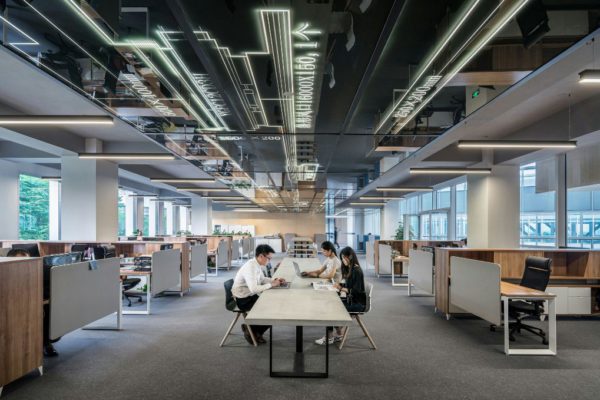
Businesses spend a lot of time thinking about productivity: better processes, improved software, and faster outputs.
But high-performing companies also pay attention to how work feels for employees every day.
In essence, this is the workplace experience.
In this post, we detail what workplace experience means, why it’s essential for engagement and productivity, and how to improve it through workplace design, culture, feedback loops, and office management software like Ronspot.

Free Desk Sharing Ratio Calculator
Turn workplace experience into data—try the free Desk Sharing Ratio Calculator to see if your space matches demand
What is Workplace Experience?
Workplace experience refers to the environment, systems, and culture that shape how employees feel and function at work.
Creating a workplace experience involves three core pillars.
The 3 Pillars of Workplace Experience
1. The workplace environment
The physical office space is a fundamental part of the workplace experience. But it isn’t just about interior design. It’s about how easily employees can access the spaces and resources they need, like desks, meeting rooms, quiet zones, breakout areas, and more.
Can your team book a desk in advance? Do they know which spaces are free? Are rooms double-booked?
Good workplace experience design ensures that your environment is flexible, well-organised, and friction-free.
When employees can reliably access desks, meeting rooms, and shared spaces, they spend less time navigating logistics and more time doing meaningful work.
2. The workplace technology
Workplace experience transcends the physical. The digital tools your team uses daily are just as important.
From desk booking apps and communication platforms to file-sharing systems and workflow automation, technology plays a major role in helping employees get work done smoothly.
A positive digital workplace reduces friction, saves time, and helps teams stay connected, especially in hybrid or remote settings.
The best technology is not just feature-rich. It is easy to adopt, integrated with daily workflows, and transparent enough that teams trust the data behind workplace decisions.
3. The workplace culture
The people, the values, and the shared behaviours define your workplace culture.
A positive culture promotes inclusion, collaboration, respect, and trust. It helps employees feel seen and supported in their day-to-day roles. It also enables better communication across departments and encourages teams to share, learn, and grow together.
Culture is often what determines whether workplace policies succeed or fail. Two companies can use the same tools, but the one with stronger trust and communication usually gets better outcomes.
Why Is a Positive Workplace Experience So Important?
Many employees today are disengaged in their work and workplaces, and it’s having a detrimental impact on productivity and bottom lines.
- Only 23% of employees globally are engaged at work.
- Over 62% are disengaged and doing the bare minimum required.
- It’s estimated that this lack of engagement is costing the global economy $8.8 trillion annually.
Put simply, building a better workplace experience leads to better business outcomes.
It improves employee retention, supports stronger manager effectiveness, and reduces hidden operational costs caused by poor coordination and underused office space.
4 Key Business Benefits of Better Workplace Experience
1. Increase Employee Engagement
When employees feel supported by their workplace – physically, digitally, and emotionally – they are more likely to engage deeply with their work. Engaged employees are more productive, creative, and committed to their roles.
2. Increase Employee Satisfaction
A well-designed workplace supports both the mental and physical well-being of employees. Whether that’s providing quiet focus areas, ergonomic workstations, or flexible hours, small changes to the workplace experience can lead to big improvements in satisfaction and performance.
3. Efficient Space Usage
Good workplace experience planning includes how your space is used. If employees can easily book a desk or reserve a meeting room, they waste less time and avoid frustration, especially in shared or hybrid work environments. Smart space usage also reduces costs and increases operational efficiency.
4. Makes Hiring (and Retention) Easier
A positive workplace experience improves your reputation as an employer. It signals that you care about the needs of your team, and that can be a powerful differentiator in a competitive talent market. When people enjoy coming to work, they’re more likely to stay.
How Can You Improve the Workplace Experience?
4 Practical Ways to Improve Workplace Experience
1. Embrace employee feedback
Gathering feedback and insights from employees is key to building a workplace experience that serves their needs. Here are some simple steps to start:
- Make it easy to give feedback. The harder you make it for employees to share what’s on their minds, the less likely they are to engage.
- Ask for it on a regular basis. Use your internal communication channels, like company emails or in-person meetings, to remind employees to share any positive or negative feedback they have.
- Open up various communication channels. Whether it’s monthly team meetings and one-on-ones, or more discreet channels like questionnaires and surveys, allow employees to communicate with you in the way they feel comfortable.
- Act on the feedback. There’s nothing employees hate more than offering their insights and opinions only to feel like they’ve been disregarded or ignored. Close the feedback loop by acknowledging the input and making a plan of action around it.
If you’re unsure how to prompt feedback from your employees, the following questions act as a starting point for discussion.
- Does our office environment support everyone’s unique work styles?
- Are our schedules flexible enough to balance both personal and professional commitments?
- Do team members have the tools and spaces they need to do their best work?
- Are we fostering enough opportunities for collaboration between colleagues and managers?
- What could we do to elevate the employee experience?
2. Create a great office space
The design of a physical workspace can have a huge impact on how employees feel about spending time in it. If your office is uncomfortable, difficult to navigate, or lacking key facilities, it will negatively impact motivation and performance.
Designing an office space is more than adding a free beer tap and a ping pong table; it’s about considering what your employees need within the office walls to thrive at their jobs.
Modern office design prioritises:
- Facilities that support productivity through ergonomic desks, good lighting, and reliable connectivity
- Quiet spaces to support deep focus and reduce distractions
- Breakout zones and shared areas to encourage informal collaboration and downtime
3. Build a strong company culture
A positive culture is the foundation of a great workplace experience. Without it, even the best-designed office or most advanced tools won’t fully support your people.
So, how do you build culture in a way that lasts? It starts with consistent, intentional practices:
- Foster a sense of community: Support employee-led initiatives, team activities, and informal connections that help people feel part of something bigger.
- Encourage cross-team collaboration: Promote shared projects, open communication, and knowledge sharing across departments.
- Recognise contributions: Celebrate wins, big or small, and acknowledge individual and team efforts.
Culture is shaped every day by how teams interact, support one another, and share responsibility.
4. Hire a workplace experience manager
Also referred to as an Employee Experience Manager, this role is dedicated to shaping and managing the overall workplace experience, from the physical environment and digital tools to culture and communication.
Their job goes far beyond planning office events or handling HR check-ins. A Workplace Experience Manager plays a strategic role in ensuring that every part of the work environment supports productivity, collaboration, and employee wellbeing.
Key responsibilities include:
- Improving onboarding processes so new hires feel welcomed, equipped, and connected from day one
- Streamlining space usage through desk booking systems, meeting room scheduling, and workplace analytics
- Gathering and acting on employee feedback to identify friction points and continuously improve the day-to-day experience
- Collaborating with HR, IT, and facilities to align tools, policies, and physical space with employee needs
- Championing culture initiatives that strengthen engagement and belonging across departments and locations
Hiring someone for this role sends a clear message: your business values the employee experience. As expectations for the modern workplace evolve, investing in a dedicated leader to own and optimise this area is no longer optional; it’s a competitive advantage.
How Do You Measure Workplace Experience?
Core Metrics to Track Workplace Experience
Tracking workplace experience helps you identify what’s working and where to improve.
Here are three ways to start:
- Employee Surveys: Conduct regular surveys to track employee satisfaction and engagement over time. They’re a simple way to spot patterns and areas for improvement.
- Exit Interviews: Departing employees often provide honest feedback about their experience. Use this insight to identify common issues and make meaningful changes.
- Utilisation Data: Review data from desk and meeting room bookings to see how your space is used.
Measuring workplace experience requires both numbers and insight to work. Combining data with qualitative feedback helps build a full picture.
A practical measurement cadence is to review utilisation and survey trends monthly, then align action owners for the top two or three friction points each quarter.
Invest in a Platform That Prioritises Workplace Experience
Expectations around the workplace have changed since the pandemic. Many employees are now demanding the option to work from home or the flexibility to only come into the office on a hybrid basis.
This makes workplace experience more complex to design and manage. How can you improve hybrid workplace experience while still encouraging remote workers to use the office for the moments that matter most?
One strategy is to make the office journey as stress-free and predictable as possible, from planning the day to arriving onsite and finding the right workspace quickly.
With a platform like Ronspot, you give employees the ability to access and manage the workplace on their terms. That means:
Ronspot works as an operational layer for the modern workplace, connecting employee experience with real execution. Teams can plan office days with confidence, book the resources they need in advance, and avoid the day-to-day friction that weakens engagement and productivity.
For workplace leaders, this also improves decision quality. Instead of relying on assumptions, they can use workspace and booking data to understand demand patterns, remove bottlenecks, and optimize policy over time.
Why this matters for hybrid teams
Hybrid work only succeeds when office time is intentional and easy to coordinate. If employees cannot quickly secure desks, rooms, or parking, office attendance becomes stressful and inconsistent. Ronspot helps remove that uncertainty and supports a workplace experience people actually want to use.
- Desk Booking Systems: Let employees reserve their preferred workspace before they come into the office
- Parking Reservations: Ensure a smooth commute with pre-booked spaces and real-time space management
- Meeting Room Booking: Manage meeting room scheduling without conflicts and delays.
- Workplace Analytics: Understand space usage and make informed decisions
Ronspot helps teams create a workplace experience that’s seamless, efficient, and aligned with how people actually work in hybrid environments.
Conclusion
Workplace experience is no longer a soft concept. It is a measurable business lever that influences engagement, productivity, retention, and operational efficiency. Organizations that design this experience intentionally, and support it with the right systems, build more resilient teams and stronger long-term performance.
Ready to elevate your workplace experience? Book a demo with Ronspot and discover how to make every square metre work smarter for your team.