According to reporting from The Telegraph, one in four people could work from home permanently as companies continue adapting to long-term changes in employment patterns. Flexible working is no longer a temporary workaround. It is now a core operating model for many organizations.
That shift changes how leaders think about productivity. The old productivity formula was mostly office time plus direct supervision. The current reality is different. Teams now deliver work across distributed locations, variable schedules, and mixed collaboration rituals.
The key challenge is not choosing between office and home. The key challenge is building a model that combines both effectively and keeps people aligned around outcomes.
In this expanded guide, we keep the same practical foundations from the original article and go deeper into how to make them work consistently across remote and hybrid teams.
How to increase productivity when they are working from home
1 – Motivate Your Team
Motivation becomes fragile when teams lose daily in-person contact. In remote setups, managers need deliberate routines to replace spontaneous encouragement that happened naturally in an office.
A practical approach is to create recurring rhythm points: short morning alignment, weekly wins recap, and role clarity checkpoints. These rituals do not need to be long, but they need to be consistent.
Video calls through Teams or Zoom remain useful, but productivity increases most when meetings are paired with clear follow-through. Motivation grows when employees can see progress, ownership, and recognition in the same cycle.
2 – Change the Structure
Remote productivity is rarely a people problem. It is usually a workflow design problem.
If teams still use office-era processes in a distributed setting, they create delays, duplicated work, and meeting overload. Structure should be redesigned around asynchronous collaboration, clear handoffs, and visible priorities.
A practical standard is to define:
- what decisions require live meetings
- what can be resolved asynchronously
- how long each task stage should take
- who owns final approval
When structure is clear, teams spend less energy coordinating and more energy producing.
3 – Empathize so Creativity Flows
Empathy is not a soft skill in this context. It is a productivity driver.
People produce better work when they feel psychologically safe, especially during uncertain periods. Managers who understand personal constraints can allocate work more intelligently and avoid burnout cycles.
Empathy also supports creativity. When people feel heard, they share ideas earlier, challenge assumptions more constructively, and collaborate with less defensiveness.
4 – Business Culture
One major risk of sustained remote work is cultural dilution. People can deliver tasks and still feel disconnected from the organization.
That is why culture needs active reinforcement through communication rituals, peer visibility, and cross-team interaction formats. Virtual watercooler sessions, mentoring circles, and informal project showcases are practical options when designed intentionally.
Culture becomes stronger when teams experience shared standards, not only shared slogans. In practice, this means clear expectations on response times, collaboration behavior, and accountability.
5 – Coordinate
Coordination is where many productivity strategies fail. Remote work blurs boundaries between home and office and increases role overlap in daily life.
Teams need lightweight rules for time management, meeting discipline, and documentation quality. Without this, information gets trapped in private chats or repeated meetings.
A high-functioning remote team usually does three things well:
- writes decisions in shared spaces
- defines ownership for every priority
- keeps meeting agendas outcome-focused
Ultimately, productivity comes from synchronized execution, not individual effort alone.
Combine working from home and going to the office: Flexwork
The original article highlighted a key idea that still holds: combining home and office can be more effective than choosing one model exclusively.
Chris Herd (Founder and CEO of Firstbase) shared findings from conversations with more than 2,000 companies indicating many organizations were planning substantial office footprint reductions, often in the 50 to 70 percent range. The same trend pushed teams toward mixed schedules where employees work from home most days and come onsite for specific collaboration moments.
At Ronspot, we refer to this blended model as Flexwork.
Flexwork is not only a location policy. It is an operating model that determines when physical presence creates value and when remote execution is more efficient.
Why flexwork can improve productivity
When flexwork is well managed, teams gain three productivity advantages:
- Higher focus quality for individual work completed remotely
- Higher collaboration quality during planned onsite sessions
- Lower coordination friction because office days are intentional
This model also helps organizations align productivity with cost control. Reduced commute burden and more targeted office usage can improve employee energy while supporting better space planning.
Can Flexwork Improve Your Team’s Productivity?
The original post referenced Capgemini findings showing many organizations reported higher productivity during 2020 due to reduced commute times, flexible schedules, and improved communication tooling.
Those signals still matter today. The underlying lesson is not that remote automatically improves productivity. The lesson is that productivity improves when work design matches real task needs.
To make flexwork productive in practice, teams should define:
- Role-based work modes: Not every role needs the same onsite frequency. Clarify which activities require co-location and which are better done remotely.
- Collaboration windows: Set predictable collaboration windows for workshops, planning, and decision meetings. Keep deep-focus tasks outside those windows.
- Manager enablement: Managers need training in distributed leadership, not only tool training. Their ability to coordinate priorities directly affects output quality.
Productivity pitfalls in hybrid models
Even with a good flexwork policy, productivity can drop if common traps are ignored.
- Meeting inflation: When teams feel uncertainty, they often add meetings instead of clarifying processes. This creates context switching and execution delays.
- Invisible overload: Remote employees may overcompensate by staying online longer, which can hide unsustainable workload patterns.
- Uneven access to information: If important decisions happen in private channels, teams lose alignment and duplicate work.
- Office days without purpose: If onsite days are not tied to specific collaboration goals, they become commute-heavy and low-impact.
A practical productivity operating cadence
A simple cadence helps teams maintain productivity through uncertainty.
Daily
Run short alignment on priorities, blockers, and ownership.
Weekly
Review outcomes delivered versus planned outcomes. Adjust next week based on constraints and dependencies.
Monthly
Audit workload balance, collaboration quality, and policy effectiveness. Update operating rules as needed.
This cadence keeps productivity strategy connected to execution reality.
Ronspot and productivity in flexwork environments
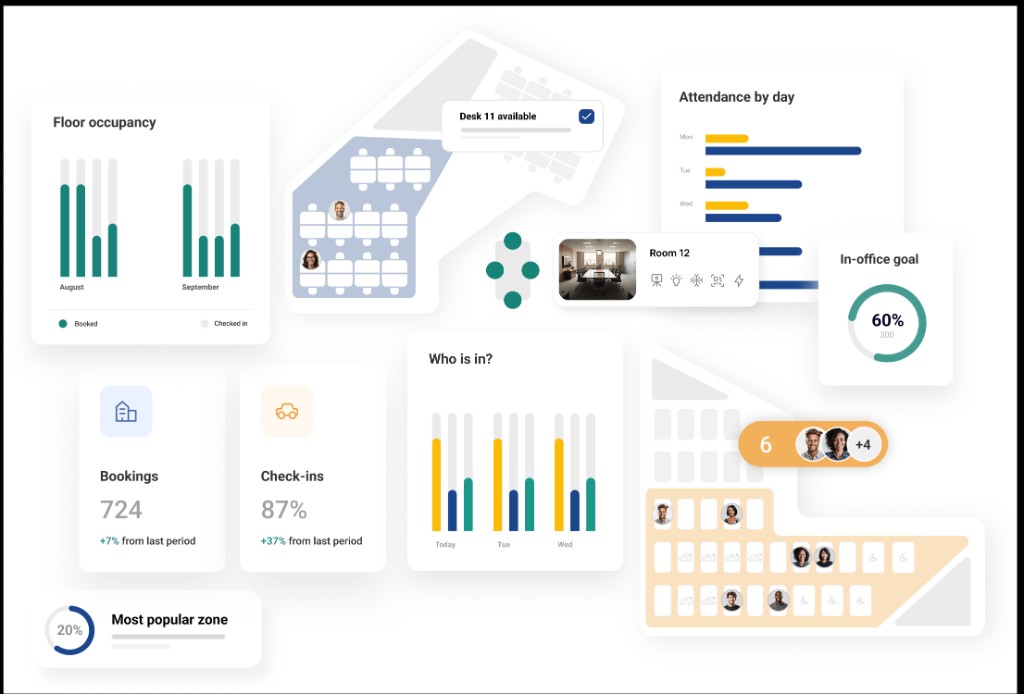
At Ronspot, we focus on making flexwork operationally reliable. Productivity drops when employees spend time guessing whether they can access desks, rooms, or parking on the days they need to collaborate.
A unified workflow helps remove that uncertainty. When teams can coordinate attendance and shared resources in one place, office days become easier to plan and more valuable.
Where productivity gains usually appear
Teams often see gains in:
- reduced planning friction for in-office collaboration
- fewer scheduling conflicts around shared resources
- cleaner operational visibility for managers and facilities teams
Why operational consistency matters
Productivity is not only about individual effort. It is also about how much organizational friction teams face before work even starts.
When operational workflows are consistent, managers can focus on output quality instead of daily logistics.
For teams scaling this model, it can help to review broader operational capabilities in product evolution 2025 roadmap, admin execution practices in Ronspot admin panel tips, and benchmark context in 2026 workplace statistics.
External references worth tracking for policy and people strategy include CIPD flexible working, IWFM workplace management, and McKinsey future of work.
Frequently Asked Questions (FAQs)
How can managers improve remote productivity quickly?
Start with clearer weekly priorities, shorter decision cycles, and explicit ownership for every deliverable.
Is flexible working always better for productivity?
Not automatically. Productivity improves when teams match work mode to task type and run consistent coordination routines.
What is the best home-office split for teams?
There is no universal split. Effective teams define role-based patterns and adjust them using delivery and collaboration data.
How do you protect company culture in remote work?
Use repeatable communication rituals, cross-team visibility, and manager behaviors that reinforce shared standards.
Which KPI should we watch first?
Begin with delivery lead time and rework rate. These show whether process clarity is improving or friction is increasing.
Can flexwork reduce costs and improve productivity at the same time?
Yes, if office days are intentional, shared resources are coordinated, and management processes are adapted to hybrid execution.
What causes productivity decline in hybrid models?
The most common causes are meeting overload, unclear ownership, and office attendance without clear collaboration purpose.
How does Ronspot support flexwork productivity?
Ronspot helps teams coordinate desks, meeting rooms, and parking in one workflow, reducing planning friction and improving operational reliability.